
Short-term lending (Repo) rate is unchanged at 8 per cent.

In her Budget speech, Finance Minister Nirmala Sitharaman on Tuesday underlined the need for collaboration between the Centre and states to take up the next-generation reforms covering land, labour, capital and entrepreneurship. As far as revenue share goes, the government has projected to give about 32.5 per cent of central taxes to states during FY25, against the 15th Finance Commission's recommendation of 41 per cent, according to the Union Budget estimate.

Finance Minister Nirmala Sitharaman's Budget proposals lay out a comprehensive road map for transforming India into a developed nation, focusing on key priorities that aim to generate ample opportunities for all citizens in "Viksit Bharat". It sets the stage for sustained economic growth, social development, and technological advancement.

'Asset allocation should be driven much more by long-term factors rather than the market scenario at any particular point in time.'

'An era of fiscal pessimism is setting in, which, if not countered intellectually, is going to have the same effect as export pessimism has had,' notes T C A Srinivasa Raghavan.

An important development is the significant increase in the direct transfers to various autonomous bodies.

A continued focus on low inflation will be important to keeping gold imports, IMF said.

People who have recovered from coronavirus infection will have to wait for up to three months before they can take a new life insurance policy, with insurers making the waiting period requirement applicable for coronavirus cases like other ailments. As a standard practice, all life and health insurance companies require people to wait for a specific period with respect to certain ailments and diseases to gauge the risk before selling a policy. This condition of waiting period for people who have recovered from coronavirus infection will be applicable only for life insurance policies.

The interim Budget proposals that will be presented on February 1 in the backdrop of the general elections scheduled in April/May 2024 are likely to have a hint of populism, believe analysts, but are unlikely to derail the government from its path of fiscal prudence.
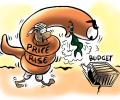
In absolute terms, fiscal deficit went up by 33.6 per cent in April-December 2017 and the revenue deficit by as much as 40.7 per cent compared to the same period the previous year, said Sudipto Mundle.

Equity benchmarks extended their decline for the fourth straight session on Wednesday, with the Sensex falling 214.85 points after the Reserve Bank raised the key interest rate by 50 basis points. Continuous foreign fund outflows and surging crude oil prices also weighed on markets. The 30-share BSE benchmark dropped 214.85 points or 0.39 per cent to settle at 54,892.49.

... if high oil prices persist or stock prices correct sharply.

The larger virtue of maintaining fiscal credibility should not be unduly diluted by quibbles on the fiscal math, says Sajjid Chinoy.

One priority for Delhi (for the new foreign secretary in particular) is to have an in-depth discussion with Dharamsala as soon as possible, suggests Claude Arpi.

Moody's Investors Service on Friday affirmed India's rating at the lowest investment grade of 'Baa3', with a stable outlook, saying high growth will support a gradual increase in income levels, but flagged risks of populist policies due to rise in political tensions. Moody's said although India's potential growth has come down in the past 7-10 years, the growth would outpace all other G20 economies through at least the next two years, driven by domestic demand. Moody's said the restoration of robust growth prospects post-pandemic, the effective commitment to inflation targeting and the rehabilitation of the financial system aided by reform supports its view of strengthening monetary and macro policy effectiveness.

US's terrible political and economic leadership will ultimately cost the dollar its value. India must act early to avoid being dragged down, suggests R Jagannathan.

'Rather than taking a very short-term view on the markets, equity investing should be premised on longer term growth opportunities.'

Talking to reporters on the sidelines of the G-20 Finance Ministers' meeting in Paris, Mukherjee said fiscal expansionary policies were required in the past, in the wake of global financial crisis.

'Any normalisation exercise will bring its share of volatility.'

Larsen & Toubro, Axis Bank, Reliance Industries, UltraTech Cement, Mahindra & Mahindra, IndusInd Bank, ICICI Bank and Tata Steel were the other big gainers. Sun Pharma, HCL Technologies, Asian Paints, Nestle and Infosys were the laggards.

Investors' wealth jumped Rs 13.78 lakh crore on Monday as the benchmark equity index Sensex hit its lifetime high after exit polls predicted a massive win for the BJP-led NDA in the Lok Sabha polls. The 30-share BSE Sensex jumped 2,777.58 points or 3.75 per cent to hit a record peak of 76,738.89 in early trade. The benchmark finally ended at 76,468.78, registering a sharp rally of 2,507.47 points or 3.39 per cent.

The impact of economic slump was visible in the Budget's fine print, as this step-by-step explanation show how the Budget math was worked out, reports Abhishek Waghmare.

The Economic Survey said that a number of indicators -- GDP, IIP, credit, investment and capacity utilisation, point to a deceleration in real activity since first quarter of 2016-17 and a further deceleration since the third quarter.

Growing at a robust rate due to economic reforms in key sectors like digitisation and infrastructure, India has emerged as a star performer and is projected to contribute more than 16 per cent of the global growth, the International Monetary Fund said on Monday. "What we have been observing for quite some time now is that India has been growing at a very robust rate. "It's one of the star performers when it comes to real growth when you look at peer countries.

Banks should neither be timid nor adventurous while lending as the loans of today should not become NPAs of tomorrow, he said.


'Nyay scheme will cost between 1.2-1.5 per cent of GDP at its peak.' 'Our nearly $3 trillion economy has the fiscal capacity to absorb this expenditure.'
Deficits could come under more pressure in coming years as states implement their own Pay Commissions.

Finance Minister Nirmala Sitharaman will set a record by presenting the sixth Budget in a row -- 5 annual Budgets and one interim -- a feat achieved so far only by former Prime Minister Morarji Desai. With the presentation of interim Budget on February 1, Sitharaman will surpass the records of her predecessors like Manmohan Singh, Arun Jaitley, P Chidambaram, and Yashwant Sinha, who had presented five budgets in a row. Desai, as Finance Minister, had presented five annual Budgets and one interim Budget between 1959-1964. The interim Budget 2024-25 to be presented by Sitharaman on February 1, will be a vote-on-account that will give the government authority to spend certain sums of money till a new government comes to office after the April-May general elections.
GDP growth of 7.7 per cent in the first half of this fiscal has "left sceptics gasping and woefully behind the curve", an RBI article said on Wednesday. It also stressed the buildup in the growth momentum is likely to be sustained. The article on the state of the economy published in the Reserve Bank's December Bulletin on Wednesday also said CPI-based retail inflation is expected to ease to 4.6 per cent in the first three quarters of 2024-25 from 5.6 per cent in November.
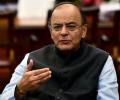
After the April-July fiscal deficit data was released on August 31, several analysts hinted that the government may need to go for cuts in capital expenditure to meet the fiscal deficit target.

For his first Budget in July 2014, Jaitley inherited a fiscal deficit target of 4.1 per cent of GDP. From 4.1 per cent, the fiscal deficit came down to 3.4 per cent by 2018-19, with two slippages from the budgeted targets, in 2017-18 and 2018-19, the former due to introduction of the GST, says Arup Roychoudhury.

In the Budget speech, Arun Jaitley had first spoken about the need to have a range.

American brokerage firm Morgan Stanley on Thursday sharply cut its India FY23 real GDP growth estimate to 7.9 per cent, mainly due to the impact of the Russia-Ukraine conflict on oil prices. Analysts at the brokerage also raised their inflation forecast to 6 per cent - the upper end of the tolerance band for the RBI - and flagged stagflation risks because of the ongoing events. "We believe that the ongoing geopolitical tensions exacerbate external risks and impart a stagflationary impulse to the economy," they said. It can be noted that stagflation involves a stagnancy in output or growth, coupled with high inflation.

By taking the mutual fund route, investors can take exposure to gilts with small amounts. Over a decade or more, returns from these funds tend to be sound.

Economists have said if a stimulus is needed it should be different from what was provided in 2008-09, when the economy faced the ripple effects of a global meltdown following the Lehman Brothers collapse.

Economists have cautioned that any deferment of the government's fiscal goals would prove counter-productive and raise the interest payment burden.

With general elections on the horizon, the government's privatisation bandwagon has almost but stalled as a government wary of being accused of selling family silver opts for minority stake sales on stock exchanges over outright privatisation. The result -- the divestment target for current fiscal year is again likely to be missed. Big ticket privatisation plans such as that of Bharat Petroleum Corporation Ltd (BPCL), Shipping Corporation of India (SCI) and CONCOR are already on the backburner and analysts feel meaningful privatisation can happen only after April/May general elections.

Commerce and Industry Minister Piyush Goyal on Monday said the existing foreign trade policy (FTP) will be extended for six months till March 31 next year. The government had earlier extended the FTP 2015-20 until September 30 this year due to the Covid-19 crisis. The FTP provides guidelines for enhancing exports to push economic growth and create jobs.

Enhanced revenue generation is a priority for the government.
 © 2026 Rediff.com - Advertise with us - Disclaimer - Privacy Policy - Sitemap - Feedback - About us - Terms of use - Grievances